



TL;DR: Push notifications deliver on-call alerts in 1–3 seconds with native acknowledgment tracking, while SMS typically takes 5–30 seconds and can run 30 seconds to 5 minutes under congestion, and hours during regional outages. On iOS, push bypasses Do Not Disturb at the OS level with critical alert permissions; SMS relies on carrier-level delivery with no confirmation a human saw it. Neither channel alone is reliable enough for critical on-call alerting. The operational standard is layered delivery: push first, SMS fallback, voice last, with every step timestamped for audit.
Your monitoring tool detected the fault. Your alerting platform sent the notification. Nobody acknowledged it. The post-incident review will ask one question: which channel failed, and why didn’t anyone catch the gap? Push notifications and SMS appear to fail in different ways, and neither closes the acknowledgment loop alone. This article compares both channels on latency, delivery guarantees, failure modes, acknowledgment tracking, and cost, then lays out the layered strategy that removes single-channel risk.
Mechanics of push versus SMS alert delivery
Push notification routing and delivery
A push notification travels from your alerting platform through a cloud messaging service to the device: Apple Push Notification service (APNs) on iOS, Firebase Cloud Messaging (FCM) on Android. This path depends on active data connectivity and OS-level notification permission. A Knock benchmark of median API response latency, which updates on a rolling window, currently shows roughly 60 milliseconds for APNs and 110 milliseconds for FCM, with end-to-end delivery typically adding 1–3 seconds.
Tracking SMS delivery to responders
SMS follows a different path: the alerting platform hands the message to an SMS gateway, which forwards it through the Short Message Service Center (SMSC) over the cellular signaling channel. The SMSC stores the message and attempts delivery until the device acknowledges at the network level. This store-and-forward architecture works without a data connection. But standard delivery reports (DLRs) confirm only carrier delivery to the device, not that a human read or acted on it. Beyond the delivery report, standard SMS provides no documented mechanism for tracking human acknowledgment.
How network outages disrupt notifications
Push requires data connectivity; a device in a dead zone cannot receive push until connectivity returns. SMS survives data outages over the cellular control channel, but during regional events that trigger message volume surges, SMSCs queue messages. A PushOwl analysis documents consumer messaging delays of 30 seconds to 5 minutes under everyday congestion, stretching to hours during regional outages. Alert traffic hits the same queues, so capacity planning should use the congested ranges in the latency comparison table rather than the best case.
Push notifications vs SMS: delivery latency
For on-call alerting, delivery latency directly affects how quickly responders can act, and it can determine whether a 2 a.m. fault gets contained in minutes or sits unacknowledged until morning.
Average push alert latency
Push notifications arrive in 1–3 seconds under normal conditions. Variance comes from device state: a phone in deep sleep with battery optimization may delay notification until the OS wakes the app. That is where critical alert permissions matter, covered below.
Measuring SMS arrival times
On a healthy direct carrier route, SMS can arrive in 1–5 seconds, per an MDS Media analysis. Across real-world routes, normal delivery typically runs 5–30 seconds. The problem is that SMS latency is carrier-dependent, route-dependent, and unpredictable, with international delivery adding further variance.
SMS delivery delays under load
During congestion, SMS queues at the SMSC and delivers in batches, with the ranges shown in the comparison table below. For on-call alerting, a delay of several minutes is functionally identical to a missed alert.
| Factor | Push Notification | SMS |
|---|---|---|
| Typical latency | 1–3 seconds | 5–30 seconds |
| Congested latency | Seconds to tens of seconds | 30 seconds–5 minutes (hours in regional outages) |
| Network dependency | Data (Wi-Fi or cellular) | Cellular signaling only |
| Delivery confirmation | Accepted by APNs/FCM, best-effort to device | DLR confirms handset delivery |
| Acknowledgment tracking | In-app with timestamp (via alerting app) | None (DLR confirms carrier only) |
| DND bypass | iOS only, via Critical Alerts | No native bypass |
| Cost model | Flat per-user | Per-message |
| Primary failure mode | OS throttling, battery optimization | Carrier congestion, A2P filtering |
Why push outperforms SMS for critical IT alerts
Push outperforms SMS for critical IT alerts because it provides acknowledgment data, OS-level override capabilities, and immunity from carrier-side filtering.
How carrier blocking affects SMS reliability
Application-to-person (A2P) SMS in the US operates under 10DLC registration requirements. Carriers including AT&T, T-Mobile, and Verizon filter or block unregistered traffic. A Voxie compliance analysis documents that major US carriers block or filter unregistered business traffic.
The risk is silent failure: unregistered A2P messages can appear sent in your system yet never reach the recipient. No error code returns. Your alerting platform sends an SMS, the carrier drops it silently, and nobody knows until the incident review.
Overcoming mobile OS delivery throttling
Push has its own silent failure mode. Android Doze mode defers normal-priority FCM messages until a maintenance window, per Google’s FCM documentation. iOS applies similar background restrictions. The mitigation is documented: high-priority FCM messages deliver immediately even during Doze, and iOS Critical Alerts (available since iOS 12) bypass mute and DND entirely. Apple requires developer approval and user permission. The operational difference: push failures are mitigable through configuration; SMS carrier blocking is outside your control.
Addressing global SMS delivery failures
International SMS introduces additional failure modes: sender ID regulations vary by country, cross-border routing adds carrier hops, and reliability varies in ways difficult to test. Push through APNs and FCM routes through one global messaging layer per platform, but final delivery still depends on the device’s network connection, and some markets rely on OEM-specific delivery channels.
iOS and Android critical alert settings
The DND bypass and the lack of feedback on whether an SMS alert has actually been seen or acknowledged are the two most important operational differences between push and SMS. On iOS, Critical Alerts override DND and the hardware mute switch. SIGNL4 delivers persistent push with iOS mute override that bypasses Do Not Disturb, and the SIGNL4 iOS app is rated 4.5 out of 5, with reviewers citing DND bypass as the capability that solved their missed-alert problem. On Android, high-priority notification channels with battery optimization exclusions counter Doze-mode deferral and keep delivery reliable, but they do not override the user’s Do Not Disturb setting. The SIGNL4 Android app holds a 4.2 rating.
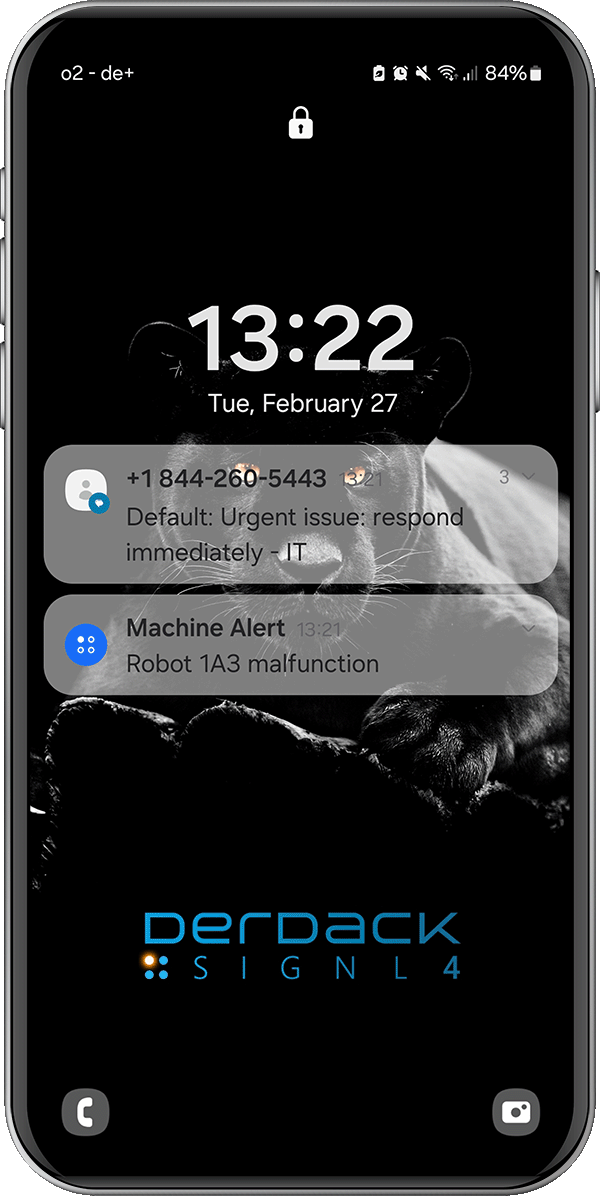
SMS has no equivalent mechanism. A text arrives as a standard notification; if DND is active, it sits silently in the tray. No carrier-level override exists.
Acknowledgment tracking and proof of delivery
When the incident review asks “who was notified, when, and what did they do,” the channel determines whether you have an answer.
Push notification response tracking
Push notifications delivered through an alerting app support in-app acknowledgment: the responder taps, the platform records a timestamp, and escalation stops. If no acknowledgment arrives within a configured window, escalation fires automatically. This creates a per-alert audit trail: delivered at 2:07 a.m., acknowledged at 2:09 a.m., escalated at 2:14 a.m., every step timestamped and attributed.
The risks of SMS acknowledgment gaps
SMS is fire-and-forget, so there is no signal to build acknowledgment or escalation on. Some platforms implement reply parsing (“reply 1 to acknowledge”), but this depends on manual action, gateway routing, and correct parsing. Teams tracking MTTA and MTTR with SMS-only alerting assemble timelines from phone logs and manual reconstruction.
Verifying alert receipt for audits
SOC 2 logging controls (CC6.1 and CC7.1) require capture of authentication, privileged access, and configuration events with audit-ready retention, per an AuditPath reference. HIPAA requires organizations to retain Security Rule documentation for six years under 45 CFR 164.316(b)(2)(i), per the same AuditPath reference. Neither mandates a specific notification channel, but both put incident records and response evidence under audit review. SMS alone produces no record of human response, so a fire-and-forget text leaves that part of the incident timeline undocumented.
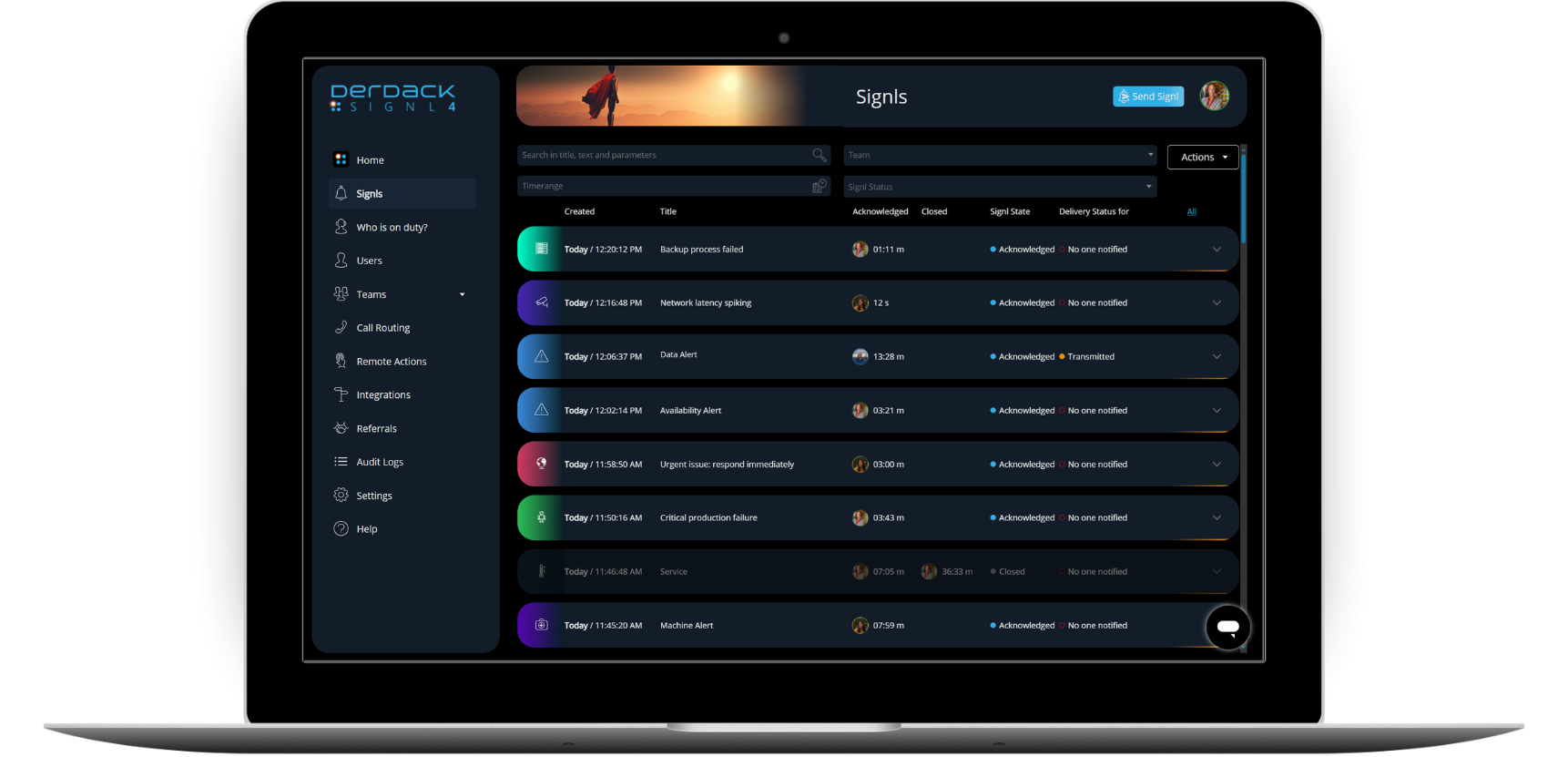
SIGNL4 tracks per-alert acknowledgment from the Notify & Connect plan upward. The Maximize plan adds system and configuration audit logs with custom retention. Our compliance posture (ISO/IEC 27001:2022, TISAX, GDPR) is documented at trust.signl4.com. We do not hold SOC 2 Type II or HIPAA certification, and we name that openly so teams in regulated industries can evaluate fit.
Strategies to avoid silent alert failures
The goal is not a channel that never fails but a delivery chain where no single failure goes unnoticed.
Addressing silent push notification failures
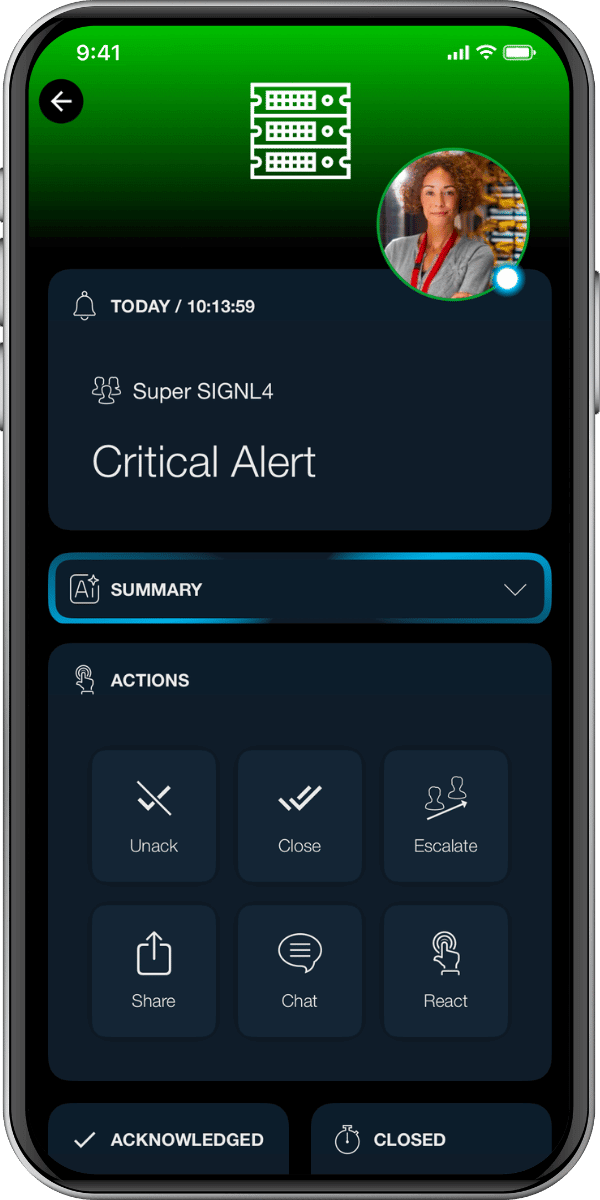
Android Doze mode and iOS background restrictions are the most common causes of silent push failure: a phone on a nightstand enters deep sleep, and normal-priority notifications queue. The fix operates at two levels: use high-priority channels on Android and Critical Alerts on iOS, and exclude the alerting app from battery optimization. Both are configuration items requiring MDM policy or manual onboarding setup. Persistent notifications add another layer, repeating until acknowledged. SIGNL4 implements this pattern: the alert fires until someone taps acknowledge, closing the loop between delivery and ownership.
Troubleshooting delayed SMS alert delivery
Check carrier delivery reports first: a late-timestamped “delivered” DLR indicates queuing; a missing DLR suggests filtering. For US A2P traffic, verify 10DLC registration status. For international delivery, low-reputation sender IDs get throttled. Test under realistic conditions (overnight, peak hours, different carriers) to surface variance business-hours testing misses.
Ensuring alerts bypass power settings
The mitigation checklist:
- Exclude the alerting app from battery optimization in Android settings.
- Enable Background App Refresh on iOS.
- Use critical alert permissions (iOS) or high-priority channels (Android) for critical alerts.
- Test overnight delivery on actual devices with DND and battery saver active.
These steps address push only. SMS has no OS-level override capability.
Calculating total cost of ownership for alerting
Comparing push and SMS pricing models
Push carries no per-message cost: APNs and FCM are free services from Apple and Google. SMS carries a per-message cost that scales linearly with alert volume.
SMS per-message pricing
US domestic rates typically range from $0.01 to $0.05 per segment depending on volume. A 10-person team receiving 50 alerts per shift across 30 shifts generates 15,000 SMS messages monthly: $300/month at $0.02 per message, on top of the platform subscription.
Regional SMS delivery pricing
International surcharges vary by destination, making SMS budgeting unpredictable for global teams. SIGNL4 uses flat per-user pricing with no per-message SMS charges. The Notify & Connect plan starts at $9 per user per month on annual billing and includes SMS and voice delivery: cost scales with team size, not alert volume.
Strategy: combining push and SMS for coverage
The operational answer is layered delivery: push first for speed and acknowledgment, SMS fallback for data-outage scenarios, voice last for unacknowledged critical alerts.
Reducing latency and messaging costs
Push-first design routes every alert through the fastest, cheapest channel. SMS fires only when push fails or goes unacknowledged, so SMS costs stay proportional to escalation events rather than total volume, or are included outright with SIGNL4’s flat per-user pricing. Most alerts get acknowledged on the push layer; SMS becomes the exception path.
Automating SMS for unacknowledged events
The escalation trigger is the acknowledgment window: if the primary responder does not acknowledge push within a defined period (5 minutes is a common standard), the platform fires an SMS. If SMS goes unacknowledged, the alert escalates to the next tier. The system tracks acknowledgment and escalates without human intervention.
Final escalation via automated voice
Voice is the last resort: harder to ignore, works on any phone, bypasses silent mode on most devices when configured appropriately. It is expensive per call and slow compared to push, acceptable for a tier that fires only when both push and SMS have failed.
Configuring reliable alert workflows
- Push first: Persistent push with critical alert permissions (iOS) or high-priority channel (Android). 5-minute acknowledgment window.
- SMS fallback: If unacknowledged, fire SMS to the same responder. 3-minute window.
- Voice last: If still unacknowledged, initiate a voice call and simultaneously escalate to backup via push.
- Escalation chain: If no acknowledgment on any channel within 10 minutes total (5 on push, 3 on SMS, roughly 2 on voice), escalate to secondary responder and notify the escalation manager.
- Audit trail: Log every delivery attempt, acknowledgment, and escalation with timestamps per compliance requirements.
SIGNL4 implements this exact pattern, connecting to monitoring tools through 200+ native integrations including Zabbix, PRTG, Nagios, Checkmk, and Icinga. Persistent push with mute override fires first, SMS fallback triggers when the window expires, and voice closes the chain. The 30-day free trial includes full Maximize plan features for up to 10 users, no credit card required, long enough to test layered delivery across a full shift rotation.
FAQs
Which is more reliable for on-call alerts, push or SMS?
Push is faster (1–3 seconds) and provides native acknowledgment tracking, but neither channel alone is reliable enough for critical on-call alerts. The operational standard is layered delivery: push first, SMS fallback, voice last.
Can push notifications bypass Do Not Disturb on iOS?
Yes, with the Critical Alerts entitlement. Apple grants this to approved developers, and the user must grant permission during setup. Critical Alerts override both DND and the hardware mute switch.
Do SMS alerts work without internet connection?
Yes. SMS travels over the cellular signaling channel, not the data channel, so it works when Wi-Fi and cellular data are unavailable. This is SMS’s primary reliability advantage over push.
What happens if both push and SMS fail?
A layered system escalates to an automated voice call and notifies the next tier. Every attempt is logged with a timestamp, so the audit trail shows exactly where the chain broke.
How long does SMS delivery take compared to push?
Push typically arrives in 1–3 seconds. SMS takes 5–30 seconds under normal conditions, stretches to 30 seconds–5 minutes under everyday carrier congestion, and can take hours during regional outages.
Key terms glossary
Acknowledgment: A recorded confirmation that a specific responder received and accepted responsibility for an alert, typically with a timestamp.
APNs (Apple Push Notification service): Apple’s cloud messaging service that routes push notifications to iOS devices.
DND bypass: The ability to override a device’s Do Not Disturb setting so a critical alert produces sound and vibration. Available on iOS via Critical Alerts, while on Android high-priority channels address Doze deferral but do not override Do Not Disturb.
Escalation chain: A pre-defined sequence of responders and notification channels that an alert follows when the primary responder does not acknowledge within a configured window.
FCM (Firebase Cloud Messaging): Google’s cloud messaging service that routes push notifications to Android devices.
MTTA (Mean Time to Acknowledge): The average time between alert delivery and responder acknowledgment, a core operational metric for on-call teams.
MTTR (Mean Time to Resolve): The average time between alert delivery and incident resolution.
Mute override: The capability of a push notification to produce audible alert sound even when the device’s hardware mute switch is on. Requires Critical Alerts permission on iOS.
Persistent notification: An alert that repeats or continues until the responder acknowledges it, rather than displaying once and disappearing.
SMSC (Short Message Service Center): The carrier infrastructure that stores and forwards SMS messages to recipient devices over the cellular signaling channel.
