
Are you tired of dealing with IT incidents that seem to happen at the worst possible time? Do you find yourself struggling to keep track of alerts, responsibilities, and ongoing tasks during critical disruptions?
If so, it may be time to modernize your incident management strategies.
In this article, we’ll explore the key pillars of IT incident management, ITIL best practices, incident response workflows, and how automation and incident management software can help organizations improve service quality and accelerate incident resolution.
Introduction to IT Incident Management
IT incident management is the process of detecting, managing, and resolving IT incidents in order to minimize the impact on business operations and critical services.
Incidents can range from:
- hardware failures,
- software outages,
- service degradation,
- cyber incidents,
- security breaches,
- and other unplanned disruptions.
The goal of incident management is to restore normal operations as quickly as possible while minimizing operational risk and maintaining service level agreements (SLAs) and service level objectives (SLOs).
From Incident Identification to Post-Mortem Analysis
The incident management process covers the entire incident lifecycle – from incident identification and incident logging to incident prioritization, investigation and diagnosis, incident response, incident resolution, and post-mortem analysis.
It typically includes:
- incident identification,
- incident logging,
- incident prioritization,
- investigation and diagnosis,
- incident response,
- incident resolution,
- and incident reviews and post-mortem analysis.
Because incidents often impact multiple systems and teams, the process usually involves various stakeholders, including DevOps teams, IT departments, support personnel, and business owners working together to restore critical services as quickly as possible.
The Importance of Best Practices, Roles and Responsibilities
Best practices help organizations establish structured processes for handling incidents consistently and efficiently.
Without clear workflows and escalation procedures, even a minor incident can quickly escalate into costly service disruptions.
Some important best practices include:
- establishing clear roles and responsibilities,
- defining escalation procedures,
- prioritizing incidents based on business impact,
- tracking incidents through a centralized service management tool,
- and implementing continuous improvement strategies.
By following these practices, organizations can improve SLA management, maintain SLA compliance, reduce operational risk, and improve overall service quality.
Understanding ITIL and Types of Incident Management
ITIL (Information Technology Infrastructure Library) is one of the most widely used frameworks for IT incident management and service operations.
It provides structured guidance for:
- incident management,
- problem management,
- change management,
- knowledge management,
- and service request handling.
Many organizations use ITSM platforms to support these processes and improve incident response workflows.
Different types of incident management require different response strategies. For example:
- a service request follows a different workflow than a cybersecurity incident,
- while a critical application outage requires faster escalation than a low-priority disruption.
The standard ITIL incident management workflow includes:
- detecting incidents,
- logging incidents,
- categorizing incidents,
- incident prioritization,
- investigation and diagnosis,
- incident resolution,
- and incident closure.
ITIL also defines operational responsibilities for service desks, incident managers, technical support teams, and DevOps teams.
By following ITIL best practices and using modern ITSM tools, organizations can create structured processes that improve incident response and reduce disruptions across critical infrastructure.
Key Pillars of Incident Management Software
There are several key pillars organizations should consider when developing their incident management strategies and workflows.
Communication and Incident Response
Effective communication is critical during urgent issues, cyber incidents, and security incidents.
Teams need real-time visibility into:
- the type of incident,
- affected systems,
- assigned personnel,
- completed tasks,
- and the current recovery process.
Modern incident management tools help automate communication workflows and improve collaboration between operational teams.
Incident Logging and Documentation
Accurate incident logging and documentation are essential for effective incident analysis and long-term problem management.
Incident logs should include:
- timestamps,
- affected services,
- business impact,
- actions taken,
- escalation history,
- and recovery status.
Detailed logging also improves:
- incident reviews,
- knowledge management,
- change management,
- and future incident response strategies.
Collaboration and Automation
Modern incident management software improves collaboration through automation and real-time alerting.
Instead of relying on manual communication, automation helps organizations:
- route alerts automatically,
- trigger escalation procedures,
- notify the correct personnel,
- and reduce delays during security breaches and unplanned events.
This is especially important for DevOps environments managing microservices, cloud services, and distributed infrastructure.
Incident Management Framework and Workflows
An incident management framework provides a structured approach for managing disruptions and maintaining service quality.
A typical framework includes:
- incident response teams,
- service management tools,
- monitoring systems,
- escalation workflows,
- and reporting processes.
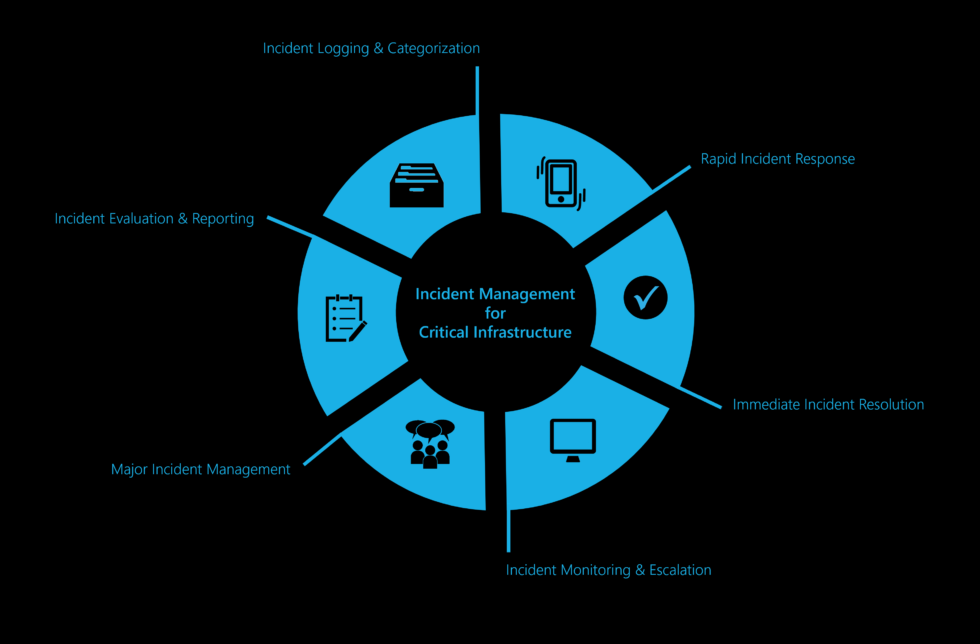
The incident response workflow often includes:
- incident identification and logging,
- categorization and prioritization,
- investigation and diagnosis,
- incident resolution,
- monitoring and escalation,
- evaluation and reporting.
These workflows help organizations respond faster while reducing operational risk and service degradation.
Monitoring, Logging, and Investigation and Diagnosis
Monitoring systems and application logs play a critical role in modern incident response.
Monitoring software helps organizations detect anomalies and identify incidents before they create major service disruptions.
However, monitoring alone is not enough.
Without automated workflows and proper escalation procedures, alerts can easily be overlooked or delayed.
This is why many organizations combine:
- monitoring tools,
- logging systems,
- ITSM platforms,
- cybersecurity solutions,
- incident management software,
- and service portals.
Together, these systems improve incident identification, investigation and diagnosis, and incident prioritization across the entire infrastructure.
Common Challenges in Incident Management
Organizations often face several common incident management challenges.
Lack of Visibility
Without centralized incident management tools, teams struggle to understand:
- incident status,
- assigned responsibilities,
- affected critical services,
- and operational impact.
This often delays incident resolution and negatively impacts service quality.
Lack of Communication
Poor communication during urgent issues can create confusion and slow down incident response.
Automated workflows and real-time alerting help reduce these delays and improve collaboration between DevOps teams and IT departments.
Lack of Structured Processes
Organizations without structured processes often experience inconsistent incident handling, slower recovery times, and increased operational risk.
This is why automation and standardized workflows are becoming essential for modern incident management.
The Role of Automation in Incident Resolution
Automation significantly improves incident response and incident resolution.
Modern incident management software can:
- automate alerting,
- trigger escalation procedures,
- route incidents to the correct personnel,
- and provide real-time updates throughout the recovery process.
This reduces manual effort and accelerates response times during:
- service degradation,
- cybersecurity incidents,
- security breaches,
- and other unplanned disruptions.
Automation is especially valuable for organizations operating critical applications, microservices, and globally distributed infrastructure.

SIGNL4 as an Incident Management Tool
SIGNL4 helps organizations improve incident response through intelligent automation and real-time mobile alerting.
SIGNL4 integrates with:
- monitoring systems,
- ITSM platforms,
- service portals,
- cybersecurity tools,
- logging systems,
- and business intelligence software.
It helps organizations:
- automate incident identification,
- improve incident logging,
- accelerate incident response,
- streamline escalation workflows,
- and improve incident resolution.
With automated alerting, mobile incident response, and real-time collaboration, SIGNL4 helps DevOps teams and IT departments reduce disruptions, improve service level agreements, and protect critical services from costly downtime.
If you wish to have a look at how SIGNL4 can benefit the revitalization of your incident management, discover its features or start a free trial.